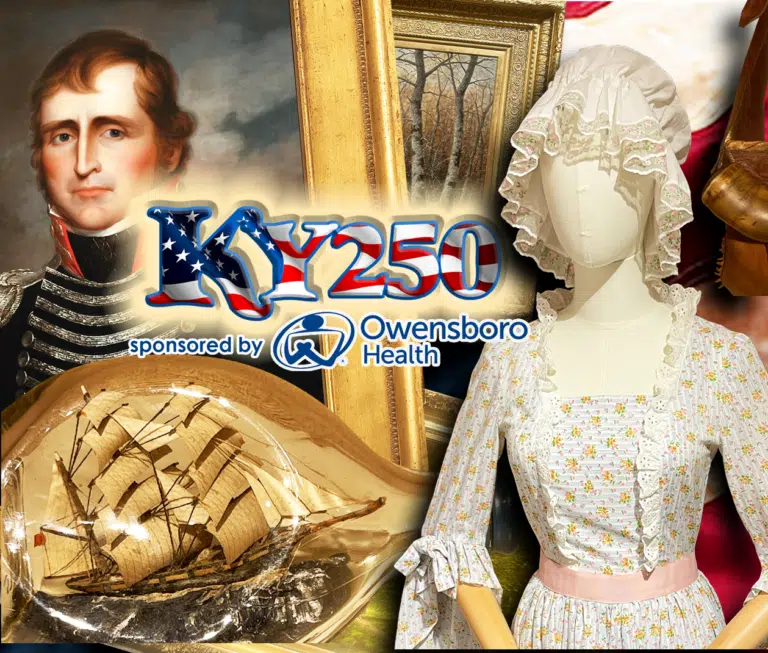
“KENTUCKY 250”, sponsored by Owensboro Health, is scheduled throough July 12, 2026 and will feature art, and artifacts celebrating the country’s Sestercentennial, the 250th Anniversary of the founding of the United States, as well as works by the most prominent artists of early Kentucky.
A special highlight of “KY250” is the public debut of two portraits of Colonel Abraham Owen (1769-1811), Owensboro’s namesake, and his wife, Martha Dupuy Owen. On loan from the Stacy family of Charleston, South Carolina, these works offer a rare glimpse into Kentucky’s early history and founding generations. Colonel Owen moved to Kentucky in 1785. He served in the legislature and was a member of the state’s constitutional convention in 1799. His and his wife’s portraits complement the OMFA’s portrait of Joseph Hamilton Daveiss, for whom Daviess County was named. Daveiss was Kentucky’s first U. S. Attorney and prosecuted the case of Aaron Burr for treason. Both Colonels Owen and Daveiss were citizens of Owensboro, Kentucky, lived through the Revolutionary period, and died together in the battle of Tippecanoe on November 7, 1811, historically deemed the beginning of the War of 1812.
“KY250” also showcases works by past and present artists who have shaped Kentucky’s identity. Spanning generations and styles, the exhibition explores the Commonwealth’s landscapes, communities, and traditions through the eyes of artists rooted in its history. More than half of the works come from the collection of Dr. R. Wathen Medley Jr. and Jeanette Napier Medley, featuring early Kentucky artists Carl C. Brenner, Paul Sawyier, Harvey Joiner, Robert Burns Wilson, and Patty Thum. David Taylor, an expert in early Kentucky art and owner of David Taylor Antiques, says of the exhibition, “The Owensboro Museum of Fine Art is providing a not-to-be-missed opportunity. The KY250 exhibition has assembled a remarkable and historically significant collection of paintings by many of Kentucky’s finest 18th and early 19th century artists.” Selections from the Museum’s Permanent Collection, including a series of paintings by Harland Hubbard depicting Owensboro’s history, complement these historic works.
Bridging art and history, on view are a series of crafted replica artifacts created by contemporary Kentucky artisans, offering visitors a tangible connection to the Commonwealth’s past. A meticulously researched American Colonial Day Dress by Paula Alex Naas, a handcrafted Frontier Possibles bag by Joe Mills, and a traditionally forged knife by bladesmith Max Soaper highlight the skill, craftsmanship, and material culture that shaped everyday life in Kentucky’s early history.
The exhibition also highlights Kentucky’s enduring tradition of craftsmanship. Showcased are miniature replicas of early American ships by Bardstown artist Jim Cantrell. Also featured are several examples of “Ships in Bottles” by Owensboro artist Greg Alvey. Leitchfield Quilters Sharon Duke and Linda Gentry created a “Teaching Wall Hanging” that depicts historical events leading to the signing of the Declaration of Independence. On Loan from the Hancock County Museum and Historical Society is a handmade replica of the steamboat Robert E. Lee, by Hawesville artist Franklin Meserve. A needlepoint by artist John Schleicher rounds out the exhibition that highlights the Commonwealth’s rich artistic heritage, family traditions, and human connection with maritime technology.
Courtesy of the Smithsonian’s National Museum of American History, three graphic reproductions coming from William D. T. Travis’s monumental Civil War panorama are also on display. Commissioned late in the American Civil War by veterans of the Union Army of the Cumberland to document General William S. Rosecrans’s career after his removal from command in 1864, the original work stretched over 500 feet of canvas.
“KY250” has been made possible through the generosity of numerous lenders whose commitment to preserving and sharing Kentucky’s history enriches this exhibition. The Museum gratefully acknowledges Dr. R. Wathen Medley and Jeanette Napier Medley, Greg Alvey, Dr. James F. Naas and Mrs. Paula Alex Naas, Jason Edward Hayden, the Smithsonian’s National Museum of American History, the Kentucky Historical Society, Jim Cantrell, Jamie DeWitt, Sharon Duke and Linda Gentry, the Stacy family, and the Hancock County Museum and Historical Society for their invaluable contributions.